
The first step of understanding
the why behind your pain is to
Learn the Contributing Factors to Your Pain

Understanding the Why Behind Your Pain...
It can lead to going down the wrong path OR going down the right path but not addressing all the contributing factors to your pain. Either way you end up with an unsatisfactory frustrating result and still in pain.
Having a diagnosis for your problem is one thing. It often brings comfort that there is a name for this thing that’s going on with me. That “I’m not the only one”. But what’s behind the diagnosis?
How did you come to this? How did you develop the stiffness, the loss of mobility, the weakness, and pain…that has left you unable to keep up and do the things you want to do? This is really the mystery that we need to solve. The mystery of your problem, the mystery of your pain.
Understanding the why behind your pain is learning all the contributing factors to your pain. Only when you are armed with this knowledge can a complete plan be created to address your pain. Giving you the control and power for the best possible shot at achieving the best possible physical version of yourself!
Gives you power. Knowledge gives you control in seemingly uncontrollable situations or problems. Not knowing all the contributing factors behind you pain can lead to bad decisions.
What Causes Pain?
Forces cause pain. Forces beyond what the structures of your body can withstand. They can be high intensity and short duration forces like in the case of direct trauma. A collision on a football field, a fall off a ladder, a motor vehicle accident to name a few. On the other end of the spectrum they can be low intensity long duration forces. As with the case of most repetitive overuse type injuries.
The three forces your body has to control are compression (being squeezed together), traction (being pulled apart), and shearing (one structure being slid on another). Now your body can recover and rebuild from a lot of stress and strain caused when these forces are uncontrolled, until it can't. You hit a point where your bodies ability to repair after the insult of these uncontrolled forces is exceeded. Basically the breakdown exceeds the recovery and you get pain and injury.

Load Transfer
Loading increasing the forces that you body has to absorb and generate. How well (or not well) you transfer load through your body with push, pull, lift, carry, walk, run and so on dictates the stress and stain that that load causes on you body. If you are efficient when loading the body there is no damage to the body, but if you are inefficient when loading the body damage occurs.
This often goes unnoticed to you until you start to struggle with loading activities or they cause you pain. Click the video to learn if load transfer could be contributing to your pain...
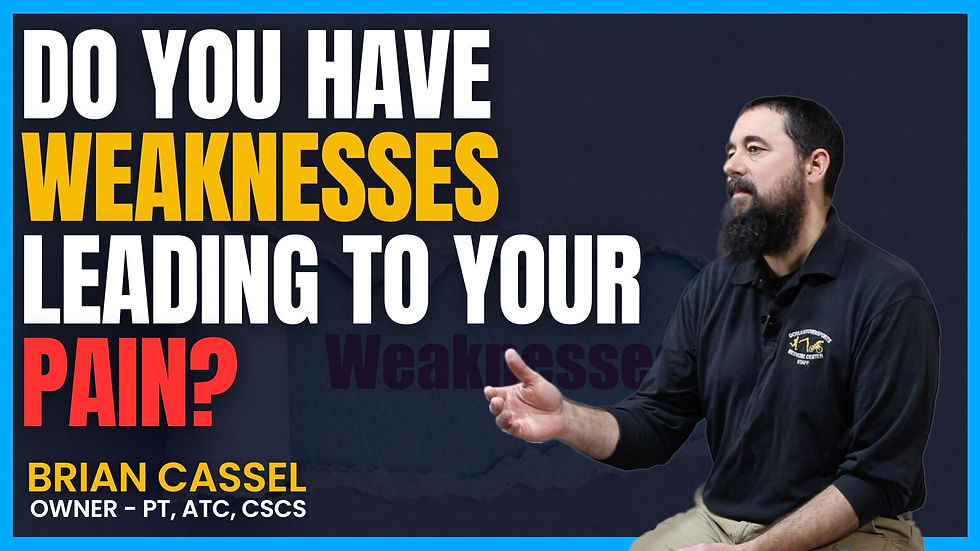
Weakness
Weakness of a muscle or movement pattern leads to compensation of a different muscle or movement pattern.
Compensation leads to imbalanced overuse that wears and tears on your body. "If you don't use it you lose" is a true cause of weakness, but there are other reasons why your body has weaknesses. Weaknesses you may not even notice your compensating for. Click the video to learn how weakness may be contributing to your pain...

Breath
Breathing is a constant force exerted on your body. Like gravity this is a force we can't avoid. It can be high intensity as when exercising or low intensity as when at rest. Your breathing pattern can be balanced and keep your body centered or it can be unbalanced and uncenter your body leading to overuse, stress and strain. Click the video to learn how your breathing pattern may be contributing to your pain...

Posture
Gravity is a low load long duration (constant) force acting on your body. Your ability to manage this force, to posture against it, is essential for your function.
How you posture against gravity will dictate the stress and strain on your body not only in static postures, but also when you move. It can lead to overuse, tightness, weakness and more. Click on the video to learn how your posture may be contributing to your pain..

Movement
How you move in life, activity and sport matters. Life for you should be a symphony of movement; balanced and centered. But when it becomes unbalance, uncentered it leads to overuse, wear and tear, breakdown and eventually injury. There are multiple ways for you to move to achieve a given task. Your brain has options with your body. But your brain wants efficiency so it will overuse a movement pattern that gets the job do faster. Which is fine until the body can't handle it anymore. Click the video to learn if your movement patterns could be contributing to your pain...

Mobility
Mobility is your ability to move across multiple areas of the body to achieve a task, like reach, push, pull, lift, or twist. Balanced, centered mobility allows each structure to achieve the task with the appropriate amount of stress on it. When you lose mobility in one area or structure it places increased mobility demand on other areas or structures to achieve the amount of motion needed. This increased mobility demand leads to increased wear and tear. Click on the video to learn how mobility issues could be contributing to your pain...
Stability
Stability is your ability to stabilize one area of your body so another area can complete a given task. Proper stability in your body is essential for optimal movement and loading, while maintaining the health of the structure being moved or loaded. What you want is central stability for peripheral strength and power.
You need a stabile foundation to work off of to function efficiently and effectively in you day to day without damaging the body. Click on the video to learn how stability issues could be contributing to your pain...
Tightness
Tightness is often the first sign in your body that something is wrong. That there is an imbalance within the system.
Tightness is the start of a downward spiral to pain. Simply stretching the tightness is merely treating the symptom. To resolve tightness you must first understand why the you are tight in the first place then you can treat the cause.
Click the video to learn how tightness may be contributing to your pain...